
Just a quick update- I now have the entries for 1982, 1985 and 1986 Stereo Review equipment reviews entered. Some great gear available during those years, including the Yamaha R-8, Polk RTA 12B, Dual CS-5000 and the Carver Amazing Loudspeaker.
Sunday, May 8, 2016


Wednesday, May 4, 2016
A Square Deal
Busy, busy. Still, found time to add the 1982 year of Stereo Review equipment reports to my excel sheet, while listening to new prog-rock- Haken's "Affinity." Includes such cool items as the Boston Acoustics A40 loudspeaker, Yamaha M-50 power amplifier and the Hafler DH-110 preamplifier. Again, please let me know if you are looking for info from a particular year.
As has been mentioned, if I were to have a super power, it would be related to semi-vintage stereo and related topics. The $10 pair of B&W DM 600i and the $7 Rotel DVD player are among my top finds. On a related note, I had the most incredible stroke of luck recently to meet a gentleman who is a virtual treasure-trove of information for a novice audio historian like myself.
Long Island, New York audio fans will no doubt be familiar with the unfortunately long-defunct retailer known as "Square Deal." Originally located on Main street in Patchogue, they eventually moved to larger digs on Waverly avenue, north of Sunrise highway (long before it became the four lane monstrosity it now is). The main street location was well before my time, and I became aware of the store through my maternal uncles, all of whom (luckily for me) have impeccable taste in good stereo. One of my favorite birthday gifts was a pair of TDK chrome tape dubs with Emerson Lake and Palmer's "Brain Salad Surgery" and Chuck Mangione's "Feel So Good" on them. I was probably 10 years old at the time. My uncles did a lot of shopping at Square Deal before they closed their doors in 1994. Some AR turntables and A/D/S/ speakers were bought there, and I eventually bought my first NAD CD player there in 1992.
So, it was as I mentioned a remarkable stroke of luck that at an event at a local community college I met a gentleman with a terrific history working in the audio industry that included being at Square Deal and later at Harman. I only barely resisted the urge to bombard E. (as he shall be known on this humble blog) with about a bazillion questions, but I was pleasantly surprised when he agreed to continue an e-mail correspondence and answer some inquiries should time permit. I was planning to limit my questions to what the nature of the audio business was like prior to home theater and what Square Deal was like in particular, but of course I've gotten ahead of myself and already asked about Infinity Kappa series speakers (" . . . Harman Manufacturing did not produce the high end EMIT tweeters. They were done by a company called Capital in Connecticut. This vendor was tied in to Madrigal Audio which became Harman Specialty and now Harman Luxury audio division . . .") and Sony ES cassette decks. At any rate, welcome E., thank you so much for indulging my instability and for sharing your knowledge of audio history. I certainly find it fascinating and no doubt a couple of readers here will as well.

As has been mentioned, if I were to have a super power, it would be related to semi-vintage stereo and related topics. The $10 pair of B&W DM 600i and the $7 Rotel DVD player are among my top finds. On a related note, I had the most incredible stroke of luck recently to meet a gentleman who is a virtual treasure-trove of information for a novice audio historian like myself.
Long Island, New York audio fans will no doubt be familiar with the unfortunately long-defunct retailer known as "Square Deal." Originally located on Main street in Patchogue, they eventually moved to larger digs on Waverly avenue, north of Sunrise highway (long before it became the four lane monstrosity it now is). The main street location was well before my time, and I became aware of the store through my maternal uncles, all of whom (luckily for me) have impeccable taste in good stereo. One of my favorite birthday gifts was a pair of TDK chrome tape dubs with Emerson Lake and Palmer's "Brain Salad Surgery" and Chuck Mangione's "Feel So Good" on them. I was probably 10 years old at the time. My uncles did a lot of shopping at Square Deal before they closed their doors in 1994. Some AR turntables and A/D/S/ speakers were bought there, and I eventually bought my first NAD CD player there in 1992.
So, it was as I mentioned a remarkable stroke of luck that at an event at a local community college I met a gentleman with a terrific history working in the audio industry that included being at Square Deal and later at Harman. I only barely resisted the urge to bombard E. (as he shall be known on this humble blog) with about a bazillion questions, but I was pleasantly surprised when he agreed to continue an e-mail correspondence and answer some inquiries should time permit. I was planning to limit my questions to what the nature of the audio business was like prior to home theater and what Square Deal was like in particular, but of course I've gotten ahead of myself and already asked about Infinity Kappa series speakers (" . . . Harman Manufacturing did not produce the high end EMIT tweeters. They were done by a company called Capital in Connecticut. This vendor was tied in to Madrigal Audio which became Harman Specialty and now Harman Luxury audio division . . .") and Sony ES cassette decks. At any rate, welcome E., thank you so much for indulging my instability and for sharing your knowledge of audio history. I certainly find it fascinating and no doubt a couple of readers here will as well.

Sunday, April 3, 2016
Fun with Excel
Whereas I am reasonably certain various versions exist on the web already, today I started my long awaited project of cataloging the equipment review I have from back issues of Stereo Review, High Fidelity and Audio. I am starting a simple list of Brand/Model/Type and MSRP for now, but will expand it to include more detailed information in the future. I did the ten issues I have for Stereo Review from 1985, plus an issue of High Fidelity from 1980 so far. For example:


This should make for a quick reference. Please let me know if you are looking for a particular piece of gear, and I will let you know if I have it. I intend to do Stereo Review 1986 next.
Saturday, March 19, 2016
NAD refurbished at Spearit Sound
I had a really great experience this past week buying a refurbished NAD C326BEE integrated amplifier online from Spearit Sound. I took the opportunity to ask some questions about NAD refurb in general, and Mr. Dick Moulding, who is the General Manager, got back to me promptly with some answers. My questions:
1.) What’s with the cocoon foam packing in the box? Is it sprayed in by NAD after the factory completes its quality testing? This may seem like a dumb question but I have a few other factory refurbished items from other companies and never saw the likes of it.
1.) What’s with the cocoon foam packing in the box? Is it sprayed in by NAD after the factory completes its quality testing? This may seem like a dumb question but I have a few other factory refurbished items from other companies and never saw the likes of it.
2.) Spearit has a
good selection of refurbished equipment, which for the nascent or cheap buyer is
something of a Godsend. For example, in this case I was looking for a smaller,
inexpensive but high quality amp to take with me to the listening rooms of
friends, with the intention of writing about their rooms and setups for Bad
Audio Reviews. I wanted a piece that would be consistent in all settings, and a
more expensive amp didn’t make sense. NAD was a perfect choice. What makes you
as the retailer choose to offer a particular product or line as a refurbished
product? Must you also carry “A-stock” of the brand?
3.) I own an NAD
3125 that is probably 30 years old and it works flawlessly. There seems to have
been a period where NAD went through some difficulties with quality control.
Would you be able to comment on that? Does the company seem to be past this
problem? I have heard similar things about Cambridge Audio (I would understand
if you chose not to comment here).
4.) What generally
is the availability of refurbished products, especially for NAD? Should I be
encouraging friends to order now before things run
out?
And here were his answers:
1.) The
foam-in-place packing is done by NAD after they have finished refurbishing the
unit. The advantage of this type of
packing is that it conforms to the unit no matter what the size or shape. It also protects from all angles.
2.) Our relation
with NAD goes back to the very beginnings of the company. We are honored to be NAD’s exclusive seller
of refurbished products and one of their top authorized Internet sellers of
A-stock as well.
3.) Parts quality
and build quality of current NAD’s is highest it has ever been. If you take the cover off your 3125 and
compare it side-by-side to the C 326BEE you just purchased I think you will be
very impressed. In the past, people
loved NAD’s because the design and the performance was so insanely ahead of the
pack for a given price that it didn’t matter if it wasn’t all that
extravagantly built. Now that
performance comes with a rather nice build.
4.) Availability
depends on the time of year and the model.
It’s always worth a look at the Spearit Sound website to see what we
have.
Thank you Mr. Moulding, for taking the time to respond. As I said in an earlier post, I got
the C326BEE for $379 shipped, and I had it in two days. I haven't had the time to do a full listen
and write up, but we plan to use it as the travelling amplifier, so we will get
to know it well. Definitely check out
Spearit of you're looking for NAD gear.
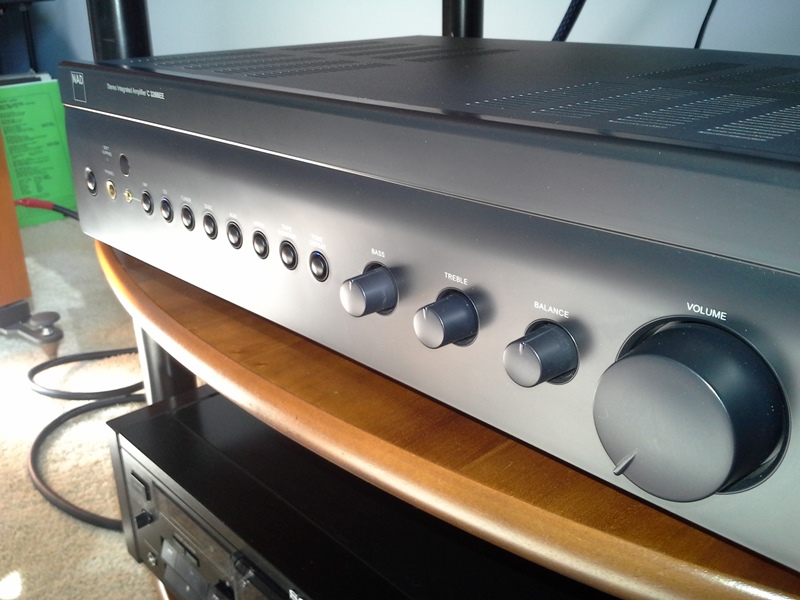
here are some quick pictures in the Am light of the C326BEE. You may see that there are some very slight marks on the top apron for the front face plate, and the top edge is slightly rough in a few spots, perhaps where the tech had to wrangle it off or on during the refurbishment process. The face plate is all plastic, as are the various control knobs, so I would imagine that it would be easy to damage them if one were not careful. Regardless, at $379 the marks are very, very minor and I did not notice them until I got the camera close. I think the C326BEE retails new for around $550, so I'd have to look at its competition at that level to see how it does build-quality wise. The interior looks very well laid out and uses quality parts, and with NAD that has always been most important. I would like to compare it to the Yamaha A-S500 integrated and see how it stands up, or the Onkyo 9010A. I have the NAD hooked up to the Dynaudio Focus 220s today and we shall see how it does with them.


here are some quick pictures in the Am light of the C326BEE. You may see that there are some very slight marks on the top apron for the front face plate, and the top edge is slightly rough in a few spots, perhaps where the tech had to wrangle it off or on during the refurbishment process. The face plate is all plastic, as are the various control knobs, so I would imagine that it would be easy to damage them if one were not careful. Regardless, at $379 the marks are very, very minor and I did not notice them until I got the camera close. I think the C326BEE retails new for around $550, so I'd have to look at its competition at that level to see how it does build-quality wise. The interior looks very well laid out and uses quality parts, and with NAD that has always been most important. I would like to compare it to the Yamaha A-S500 integrated and see how it stands up, or the Onkyo 9010A. I have the NAD hooked up to the Dynaudio Focus 220s today and we shall see how it does with them.

Monday, March 14, 2016
Refurbished NAD C326BEE from Spearit Sound
The weather in the NY metroish area hardly cooperated with rain and high winds today, but the good folks at Spearit Sound got my new amplifier to me in record time. If you'll recall, I ordered it last Thursday, no shipping charge. Total cost: $379 (!) And when I got home from work (late of course) it was on the doorstep, box just slightly damp. And what a box (actually there were 2) it was:


This is the inside box. There was one nearly twice this size on the outside. Interestingly, the box is stamped factory refurbished. Imagine my surprise when i opened it and found that the foam packing was literally encasing the amp and its accessories:

It must be something they do at the factory. I hope to get some info from the folks at Spearit about the refurb process. The packing certainly makes the delivery rather bullet proof. Not too useful for re-using though. We'll have to see about that. The amp is spartan in that NAD way:


. . . and overall I like the look. Not thrilled with the plastic knobs and front plate but what do I want for the money? It is much prettier on the inside, and that is what counts. Remember, no phono preamp and only one set of speaker binding posts. It does have an MP3 input on the front (although I would probably want to run that through a decent DAC first) and a nice tape loop. It also has preamp outs which is very useful. So, I pulled the Sony STR-GX90ES out of its spot, and here is a terrible picture (I promise better over the weekend):

I had an extra Pangea power cord out so i used that, although I think I have an Audio Quest around to try as well. very little listening was done tonight, just a couple of soundtracks through the Dynaudio Excite 14s. I will also try the NAD with the Focus 220s, but I believe that will be pushing things a bit. My initial impressions are good, more to come. Bottom line, take a look at Spearit, they have some very interesting stuff and some seriously good prices.
Sunday, March 13, 2016
None of the above!
Or below, for that matter. I ordered a refurbished NAD C326BEE and it should be here tomorrow. Initial deciding factors; preamp outs and option to use a power cord of choice. I'll do some unboxing photos, etc., and provide info on the place I purchased it from tomorrow also, if all goes well. I made 2 (!) tapes today, both on the Sony TC-K700 ES. One was a TDK SA-90, and the other a Sony ES II. I am gathering some more info regarding the TC-K700 ES for a more comprehensive post. it makes great tapes, despite my incompetence.
Always hard to sleep the night before new stereo arrives!
Always hard to sleep the night before new stereo arrives!
Tuesday, March 8, 2016
An inexpensive integrated amp or stereo receiver for summer craziness
A question: if you were to buy an inexpensive (under $450) integrated amplifier or stereo receiver that you planned to lug around to friends' houses to try out in their listening rooms with their speakers and their adult beverages, would any of these be on your list:
NAD C 316 Bee
Onkyo 9050
Yamaha R-S700
It's not like you can carry a Yamaha A-S2000 around. Do any of the list above seem like good choices? If so, why? If not, why not? Would you take your money and buy something used, or vintage and not care about the dangers of travel? let's pretend that your criteria have to include a remote control and the ability to drive a pair of Dynaudio Excite 14 speakers to a reasonable level playing a variety of music. Any suggestions?
NAD C 316 Bee
Onkyo 9050
Yamaha R-S700
It's not like you can carry a Yamaha A-S2000 around. Do any of the list above seem like good choices? If so, why? If not, why not? Would you take your money and buy something used, or vintage and not care about the dangers of travel? let's pretend that your criteria have to include a remote control and the ability to drive a pair of Dynaudio Excite 14 speakers to a reasonable level playing a variety of music. Any suggestions?
Sunday, March 6, 2016
Sony TC-K700 ES and Denon Sport quick pic
I wanted to upload the only two pictures that are sort of view-able from last weekend's tape recording session. A shot of the Denon Sport 100 minute tape I used to make one of what will certainly be many Yes mix tapes:


Interestingly, when I had the deck refurbished (that adventure is what I am writing about next), i learned that there is no "bulb" per se behind the light in the cassette well. Interesting. And, here is a shot of the copper-clad rear of the STR-GX90ES:

Which we learned has a problem with one channel of its phono output, which is a shame. If anyone can recommend a good repair outfit in the NY, CT, NJ area please let me know. I don't think Wayne at In House Repair is still open. If I am wrong about that, someone please let me know, as I need to make an appointment to bring this receiver in!
Tuesday, March 1, 2016
Phooey.
I'll post some pictures later in the week, but while making a tape of Sibelius Symphonies and a mix of Yes songs, I discovered that the Phono section of the Sony STR-GX90ES is malfunctioning. Only one channel is outputting a signal. I don't listen to a ton of records, but enough that this will be a nuisance, especially since I had planned to leave an all Sony ES set up in place for a few months. I can open the hood but given my lack of skills there is very little i can do on my own unless there is an obvious problem. At this point I'll be it would be cheaper to take an electronics class than it would be to ship the machine and have the problem repaired . . . any suggestions?
Sunday, February 21, 2016
Spring cleaning and the Sony STR-GX90ES Stereo receiver
Yesterday it was over 50 degrees Fahrenheit here in New York, so windows got opened and some much needed spring cleaning got started. This of course meant that a change in set up happened in the listening room. The Yamaha A-S2000 integrated and CD-S2000 disc player had been running the show for a long time (over a year) and I was ready for something different. I had ordered a pair of casters from Audio Advisor for the Salamander rack that holds the gear that is out of current rotation, so everything had to come off to install them anyway. Here is the mess when it was in progress:


My only real complaint with the Yamaha A-S2000 integrated amplifier is that in my room it is impossible to determine where the volume indicator is, especially in low light. This may not seem like a big deal, but when you are trying to make comparisons, having the volume consistent is useful. I decided to set up a Sony STR-GX90ES stereo receiver I got for a song on EBay some years back as the heart of the system for now. A green indicator is built into the Sony's volume knob, so that would be one matter resolved. Here is what I would up with after some futzing around:

It's an all ES system, with the Sony SCD-X5400ES as the disc player and my TC-K700ES tape deck in the "loop." (Heh.) For the earlier part of the afternoon, I had the Dynaudio Excite 14s making nice noises.

I was once the proud owner of a Sony STR-GX9ES stereo receiver that despite the best efforts of the talented folks at In House Repair (I hope Wayne is still out there) gave up the ghost. You can read about that here. I loved the way the GX9 and its more elite sibling the GX10 looked. The GX90 is a bit more streamlined, unfortunately, and all of the nifty buttons are hidden behind a drop down panel. Not everyone appreciates it, but I grew up with the clutter of buttons on black boxes from the eighties, and I miss them.

I don't have the shipping container for this machine, and I am currently hunting for an original remote (I have another that works well, but I'd like to get the full set, of course). My manual (which it shares with the GX80ES although they do not have the same feature set and performance, GX80ES omitted here for brevity, let me know if you need the information) provides the following info:
Sony STR-GX90ES FM-AM Stereo Receiver
Power output and total harmonic distortion:
With 8 ohm load, both channels driven, from 20-20,000 Hz, rated 120 watts per channel minimum RMS power, with no more than 0.008% total harmonic distortion from 250 milliwatts to rated output.
With 4 ohm load, both channels driven, from 20-20,000 Hz, rated 120 watts per channel minimum RMS power, with no more than 0.015% total harmonic distortion from 250 milliwatts to rated output.
Amplifier Section
Dynamic power output
160 watts + 160 watts (8 ohms at 1kHz IHF)
220 watts + 220 watts (4 ohms at 1kHz IHF)
350 watts + 350 watts (2 ohms at 1kHz IHF)
Harmonic distortion less than 0.008% at rated output
Frequency response
PHONO: RIAA equalization curve +/- 0.3dB
CD, DAT, TAPE, VIDEO 1,2,3 (AUDIO), ADAPTOR: 20-20kHz +/- 0.3dB
Damping factor 60 (8 ohms, 1 kHz)
PHONO MM
Sensitivity: 2.5mV
Impedance: 50 kilohms
S/N (weighting network, input level): 90dB, 80dB (A, 5mV)
PHONO MC
Sensitivity: 0.17mV
Impedance: 100 ohms
S/N (weighting network, input level): 73dB, 84dB (A, 5mV)
CD, VIDEO (1), 2, TAPE, DAT, TAPE MONITOR
Sensitivity: 150mV
Impedance: 50 kilohms
S/N (weighting network, input level): 98dB, 85dB (A, 5mV)
POWER IN
Sensitivity: 1.1 V
Impedance: 50 kilohms
S/N (weighting network, input level): 120 dB (A, 5mV)
The STR-GX90 has a set of three tone controls which allow for fine-tuning with the use of selectable turnover levels. The manual states:
BASS
Response +/- 10dB at 100 Hz Turnover frequency: 400 Hz
Response +/- 7.5dB at 100 Hz Turnover frequency: 200 Hz
MID
Response +/- 6dB at 100 Hz Turnover frequency: -----------
TREBLE
Response +/- 10dB at 10 kHz Turnover frequency: 3 kHz
Response +/- 6dB at 10 kHz Turnover frequency: 6 kHz
Overall I find the tone controls to be pretty subtle unless they are maxed out. There is an impedance selector switch on the rear panel that I must check as I switch speakers.
DIMENSIONS
w 18 5/8 x h 6 3/8 x d 17 1/4 inches
Weight: 32 lbs (which is a little over two pounds heavier than the GX80ES, interestingly)
Some other details from the manual:
The STR-GX90ES is equipped with a copper-plate rear panel for reducing distortion in high frequencies.
Optical Legato Linear A system allows the receiver to operate automatically as a class A amplifier when the level is low and as a class B amplifier when the level is high without disturbing the signal. This minimizes total harmonic distortion at every sound stage. These receivers have a spontaneous twin drive power circuit. Condensers having large capacity are used independently for the voltage amplification drive stage of the class A and power output stage of class B. Thus, a stable output and high quality sound are obtained, resulting in exclusion from power interferences. The class A stage realizes a stable operation free from interference of the power stage even when an instantaneous or strong output is received.
And they silk-screened that in Sony Gold right on the front:

Here is a so-so picture of the top. It's very nice, but does not compare with the Yamaha A-S2000 in terms of interior eye candy:

I don't have the exact info on the MSRP of the GX90ES yet, but the previous Sony ES stereo receiver flagship, the STR GX10ES retailed for $1,200 in 1990 (which is roughly $2,175 today- that's an 80 percent inflation rate, approximately).
How did an afternoon of listening go? Great. Keep in mind that I have not had the GX90 serviced, which it definitely deserves. I do not know how close to operating spec it is functioning (I need a crash course to make this blog better . . . any volunteers?) but it certainly sounded different to my ear. I am very used to a super clean and effortless sound from the Yamaha. The Sony sounds somehow . . . rounder, if that makes sense. But let's not forget that I ALSO switched out disc players, going from the CD-S2000 SACD player to the SCD-XA5400 ES. Despite owning them for some time, I still haven't done a comparison between those two. Furthermore, the GX90ES does not accept balanced inputs, so I went from Kimber XLR to Audioquest Golden Gates. To some, these changes are meaningless. To others, well, they are a big deal. At any rate, this is the intended set up for a while. I think the next post will be about the TC-K700ES tape deck and its adventure in Alamogordo, New Mexico. Stay tuned.
Monday, February 8, 2016
The NAD 3125 integrated amplifier, a Sony CDP-X55ES CD player and the Buffalo News
The A/D/S/ R1 stuff was so much fun to write about that it prompted me to get out my NAD 3125, as it is my all-time favorite amp (so far) and it was the first piece of 'high end" gear I ever owned. I guess it's high end, I'm not sure how one goes about defining that. The pictured example is my second. When I bought my first one in college in 1987 or so (have to check on that date) no one in the dorm had ever heard of NAD, and there were some big Kenwood and Pioneer fans on my floor, so people had been to Crazy Eddie's and thought they knew a thing or two about stereo. In this case high-end certainly can't be based on price, as the 3125 is a killer amp that sold for very little money, even when new. For a short time over the weekend I had it paired up with a Sony CDP-X55ES thusly:


I still had the A/D/S/ L470 out, so I was running those. Short review: if you find one, buy it. I would certainly think nothing of paying $200 USD for another one if it were in nice shape, especially if it had manual and box. Here is Junior grooving to a Jean Sibelius symphony (or was it a Tone poem?):

My sophomore year as an undergraduate at Niagara University I had a very nice Technics/Cerwin Vega system that fared well in the dorm stereo wars, but I always knew it was sort of goofy sounding. I even dragged the system down to the Rathskeller to DJ some parties, and it had a lot of cool lights and could play loud. I don't know how many drunk women asked for me to play Brown Eyed Girl on it. But it sucked for Chopin. By this time I had discovered The Absolute Sound, and I think Stereophile as well, so I was itching to get something better. I was aware of NAD and A/D/S/ for example from my Uncle's system, and I cobbled together something like $800 to upgrade (a pretty good amount for the mid eighties and my beer proclivities). Not knowing how blessed we were, back then most cities had two or three hifi shops within reasonable driving distance, and my good friend JP gave me a lift out to the Speaker Shop to get an idea for what I could afford. The Speaker Shop was (and still is thank goodness) located near the downtown State University of New York at Buffalo campus. Here is their homepage:
http://www.speakershop.com/
Please visit. They were very nice to poor college students. They let JP and I listen to Audio Research and Magnepans. I was too poor though, to do what I wanted to do: separates. I was starting from the ground up after selling the Technics set up, and for a little while I thought about dumping the whole $800 on a pair of headphones and a disc player, which probably would have provided greater fidelity. But no, I was still somewhat social then (Not now. Everyone can go straight to blazes now. Do not pass "Go," do not collect $200. I really cannot stand people), and figured I would want to play tunes for someone else (girls maybe, probably, who knows, I don't even) so headphones wouldn't cut it. I did wind up buying an $80 pair of Nakamichis anyway based on JP's recommendation, and they were great. I wonder where they are.
To make the budget work, I would need to go with an integrated amplifier (no McIntosh separates for me) and I would have to buy at least some of the gear used. Certainly the cables. Recall dear reader that this was 1987 or 1988 or both, and the interwebs only really existed then for academics to use message boards on usenet, no pretty graphics of Kate Upton in ZERO FREAKING GRAVITY, no Angry Birds. No EBay, no Craig's List (what did the Nigerian Scammers do for fun back then? Oh, right, stuff like this: http://www.ncbi.nlm.nih.gov/pubmed/2617590). To find used stereo gear I had to use the classifieds in the back of the -gasp- Buffalo News. I recall getting newsprint on my fingers. Can you imagine what treasures people were selling used in 1987? I wish I had kept those want ads. I later also used the Buffalo News want ads to buy a Dual CS-5000 from a guy who was an industrial designer working for McCormack, but that is another story (a very cool one). I wound up contacting a fellow selling an NAD 3125 integrated amplifier for the princely sum of $125. JP being the trooper that he was and is, not to mention with what must have been a morbid sense of curiosity, accompanied me to some stranger's home somewhere in Western New York one evening to see the amp. I barely recall the event now, but I do know that the amp was not hooked up. It was not plugged in. It had no documentation. It did come with a .5 meter pair of Audioquest cables. So of course I promptly bought it for the fully advertised $125, and as we walked back to the truck, JP commented that I "had big brass ones," which was a very polite way of saying that I was an idiot. Well played, no arguments there. Luckily, that amp worked. Well.
Later that week (if I recall correctly) we returned to The Speaker Shop where I dropped the remainder on a Sony CDP-208ES (yes, that's where THAT obsession started) and a pair of oak-finish Klipsch KG2 speakers, which just happened to be the perfect match for a 25 watt NAD amplifier. That's right, 25 wpc. Here are the details, per the manual:
Date of Manufacture from January 1985
PRE-AMP SECTION
Phono input
input impedence (R and C) 47 kilo ohms/ 100 picofarads
input sensitivity, 1kHz 2.5 mV ref. 25W
Signal/Noise ratio (A-weighted with cartridge connceted) 75dB ref. 5 mV
RIAA response accuracy (20Hz to 20kHz) +/- 3dB
Line level inputs
Input sensitivity (ref 25w) 150mV
Signal/Noise ratio (A -weighted ref 1W) 86dB
Frequency response (20Hz- 20kHz) +/-0.5dB
Infrasonic filter -3dB at 15Hz, 12dB/octave
Tone controls
Treble +/- 7dB at 10kHz
Bass +/- 10dB at 50Hz
POWER AMP SECTION
Continuous output power into 8ohms* 25W (14dBW)
*minimum power per channel, 20Hz to 20kHz, both channels driven with no more than rated distortion
Rated distortion 0.03%
Clipping power (maximum continuous power per channel) >35W
IHF Dynamic headroom at 8 ohms >3dB
IHF dynamic power (maximum short term power per channel) 8ohms 50W
4ohms 55W
2ohms 75W
Damping factor (ref 8ohms, 50Hz) >50
Dimensions (W x H x D) 420 x 83 x 288mm
Weight 4.7 kg
How would a puny 25 watt amp survive dorm life? Would the girls in the next dorm over even hear the opening lyrics of Black Dog blaring from the speakers hanging out of the windows at 8AM on Sunday mornings? Why yes, yes they would, if those speakers dangling dangerously from the window sill by Monster Cable XP have a 90dB sensitivity rating and that little amplifier has 3dB of dynamic headroom.
As you can see from the pictures above, the NAD 3125 is small. It's even smaller than a Rotel DVD player:

In fact, it was dwarfed by every receiver in that building, but it easily blew them away. It conquered not because it was loud, which when paired with the Klipsch's it was, but because it could play loudly and cleanly, with musicality. Its' tone controls stayed flat, its' loudness button never got used. it was accurate and just played music, and what noise it did add did not detract from the listening experience. I used to love pointing out that the CD player was NOT the amp, and all the noise was coming from the little guy on top of the disc player. Some of the more savvy accused me of using it as a preamplifier and hiding the amp elsewhere. Not so. The NAD 3125 is just super cool in a sleeper kinda way. Plus it had really, really excellent external heat sinks (a sure sign of being high end, right? Careful though, they are sharp):

As you can see from this picture, the current example I have has a coveted "Ontario Hydro Electrical" sticker, in the official orange (!). This example I bought a few years ago complete with box, packing and manual (anyone need a PDF?). The original one was unfortunately replaced by another, older and bigger NAD after I graduated, a 3150 I think. I have owned a few other NADs since (not as many as one would think, given my issues), and I have a 3130 stereo receiver in my office whose only source is a Sony TC-K606ES tape deck. I just had to have another 3125, though, and the one I have now is a forever piece. I may request that it be buried with me. They can use it to blast Bullet the Blue Sky during the wake. Now THAT is a late eighties, early nineties Catholic University Student reference for you.
This story can go in a bunch of directions from here, such as how the NAD paired with the X55ES, what happened to the KG2s (JP got them and recently sold them- shoulda called me first . . . ) or how the 3125 compares with more modern NAD amplifiers. If anyone has any preferences, let me know. For now I will warp this up by repeating- you probably want to get one of these, before they disappear forever. It is a five-star piece of kit, in my not so humble opinion.
Wednesday, February 3, 2016
Update on adsspeakerservice.com A/D/S/ R1 stereo receiver and L470 speakers
Howdy- quick update. Mr. Richard So of Richard So Electronics at adsspeakerservice.com replied to my request for information and confirmed that he is indeed still repairing A/D/S/ speakers. The site again is:
http://www.adsspeakersservice.com/
Mr. So indicates that he is the only one using original A/D/S/ parts to repair these rare speakers. If you are an A/D/S/ fan, I highly recommend that you read the "about us" on his website, as it provides a brief history of this iconic audio company. I do not currently have a need for speaker repair as my L470s are in great condition, but I will definitely keep him in mind when I find that pair of L1590s that are in need of some help!
http://www.adsspeakersservice.com/
Mr. So indicates that he is the only one using original A/D/S/ parts to repair these rare speakers. If you are an A/D/S/ fan, I highly recommend that you read the "about us" on his website, as it provides a brief history of this iconic audio company. I do not currently have a need for speaker repair as my L470s are in great condition, but I will definitely keep him in mind when I find that pair of L1590s that are in need of some help!
Subscribe to:
Posts (Atom)
